
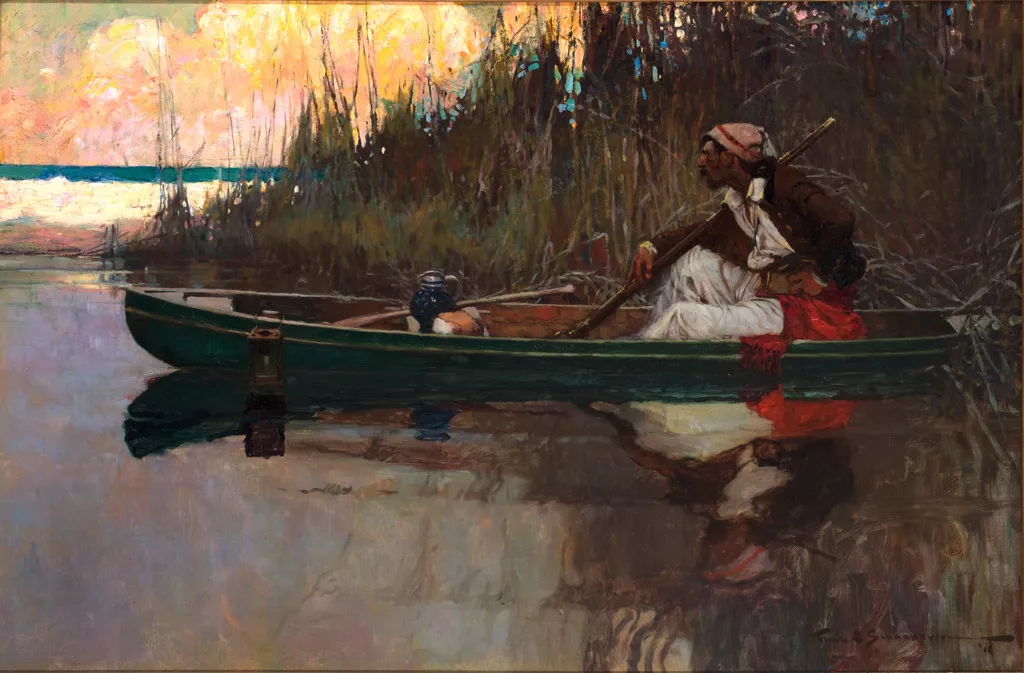
Frank Earle Schoonover (1877-1972), The Pirate, (Illustration for “In the Haunts of Jean Lafitte”), 1911, Oil on canvas, 22 x 33 in. (55.9 x 83.8 cm), Bequest of Sewell C. Biggs, 2004.411
What does 250 years of Delaware history look like through the eyes of our neighbors? To answer, we invited 25 diverse voices from across our state to serve as community curators. Each selected one piece from our collection, making Reflections: 25 Objects for 250 Years of Delaware History an exhibition curated entirely by our local community. Each post in this series features one object and the personal story of why it was chosen to represent our region’s history or felt particularly relevant to our contemporary moment.
Meet the Community Curator
John R. Schoonover
Curator
Schoonover Studios, Ltd.
Following his 1967 graduation from the University of Virginia, John established an art gallery and framing business within his grandfather’s historic studio in Wilmington, Delaware. He served as a co-editor for the Frank E. Schoonover Catalogue Raisonné, which was published by Oak Knoll Press in 2009. From 2015 to 2023, he contributed his expertise as a member of the board at the Biggs Museum of American Art in Dover, Delaware. Furthermore, he is co-editing Through His Own Lens: The Social Documentary Photography of Frank E. Schoonover, which is slated for publication in November 2026.

Curator Reflection
Frank E. Schoonover studied under noted Delaware illustrator and teacher Howard Pyle at Drexel Institute in Philadelphia during 1896 and 1900. Upon graduating, he moved to Wilmington, Delaware, to commence a remarkable career in illustration that spanned nearly sixty years. In 1906 he moved into his new studio on 1616 North Rodney Street, along with fellow illustrators Harvey Dunn, Henry Peck, Stanley Arthurs, Clifford Ashley and N.C. Wyeth. After a brief courtship, he married Martha Culbertson of Philadelphia.
Following their marriage in January 1911, Frank and Martha Schoonover honeymooned in several venues down South, including New Orleans. Enabled by Martha’s dedicated assistance, Frank traversed the area, particularly the swamps of Barataria Bay, once the home of the notorious pirate, Jean Lafitte. As Schoonover wrote: “We are now entering the real haunts of the pirates. Bayou and bayou.”[1] Schoonover observed, photographed, and absorbed the history, surroundings, lore, and culture of the bayous enabling him to write and illustrate a story titled “In the Haunts of Jean LaFitte,” Harper’s Magazine, December 1911.
Of the twelve illustrations featured in the story, Vidette in Pirogue, as titled in Schoonover’s day books, is the most compelling, but was captioned in the magazine as, “There was always on guard one who sat and watched the gulf.”[2] There is no mention of Vidette in the story. However, having found a spot among the tall Baratarian reeds, Schoonover might have felt like a Vidette himself. “I paddled about in just such a green pirogue as you see in the picture….took up my position back of a fringe of salt marsh grass and watched the Gulf.”[3]
Schoonover’s photographs of the Barataria region are featured in the book, Through His Own Eyes, The Social Documentary Photography of Frank E. Schoonover, published by Oak Knoll Books, New Castle, DE, in 2026.
[1] Frank E. Schoonover, “In the Haunts of Jean LaFitte, Harper’s Magazine
124, no. 734 (December 1911).[2] Ibid.[3] Ibid.
About the Artist
Schoonover’s teacher, Howard Pyle, taught his students to seek a sense of authenticity in their work by studying details of historic costume and decorative arts. The jug and lamp in this painting were based on real objects that Schoonover collected and kept in his studio. However, there are few records regarding what pirates wore. In his own work, Pyle blended seafarer imagery with Spanish Gypsy (Roma) attire featuring bandanas, earrings, and sashes. Though historically inaccurate, the flamboyant image he created became popular and influenced later pirate imagery, including his students’ work.
Schoonover’s painterly approach to his illustrations, including “The Pirate,” have contributed to their enduring appeal. Here, the boat divides the composition in half horizontally. The rosy sky is reflected in lavender tones below and the seated figure is mirrored in the subtle, lapping waves. The tall grasses close off the view of the landscape in the far distance, focusing attention on the alert sentry, ready for action. The vivid cadmium red used for the sash was a signature element of the artist referred to as “Schoonover Red” and was often varnished more heavily to heighten its intensity.
Engage Beyond the Artwork
Howard Pyle and Frank Schoonover influenced the public’s perception of the look of the classic pirate due to few historical records of what pirates wore. When you hear the word “pirate,” what is the very first visual detail or image that pops into your mind?
About the Exhibition
On view until January 3 – Reflections: 25 Objects for 250 Years of Delaware History is an exhibition curated entirely by Delaware community members reflecting on the nation’s 250th anniversary.
Visit and explore all 25 objects, community reflections, and the opportunity to add your own reflection.