
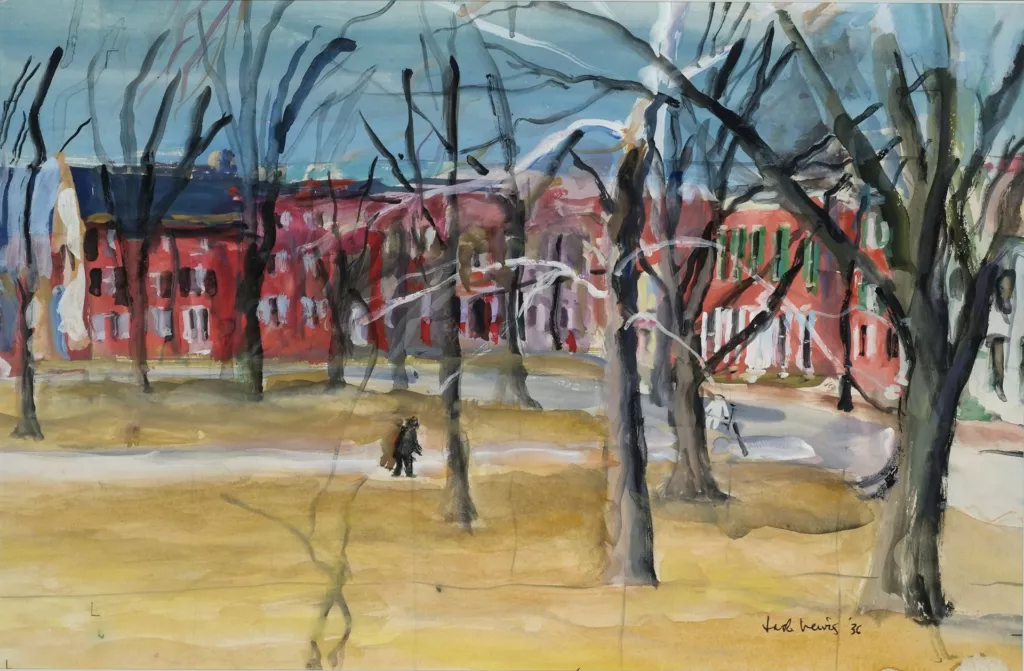
Jack Lewis (1912-2012), Dover, The Green, 1936, Watercolor on paper, 17 3/8 x 22 ¼ in. (44.1 x 56.5 cm), Gift of Paul B. Baker and Family, 2008.5.5
What does 250 years of Delaware history look like through the eyes of our neighbors? To answer, we invited 25 diverse voices from across our state to serve as community curators. Each selected one piece from our collection, making Reflections: 25 Objects for 250 Years of Delaware History an exhibition curated entirely by our local community. Each post in this series features one object and the personal story of why it was chosen to represent our region’s history or felt particularly relevant to our contemporary moment.
Meet the Community Curator
Nicole Worthley
Park Superintendent
First State Heritage Park
Nicole Worthley-Hall was born in New Castle and grew up loving the history around her-loved fueled by not only her father’s interest, but by a simple 5th grade field trip to Fort Delaware State Park. While earning her B.A. in History and minor in Anthropology at the University of Delaware, she reignited her interest in public history by returning to Fort Delaware as an intern and later seasonal employee.
Working at several historic sites and museums throughout Delaware and eventually becoming Superintendent of First State Heritage Park, Nicole then earned her M.A. in Museum Studies from Johns Hopkins University and is hoping to spark the same passion she feels in others by ensuring First State Heritage Park runs successfully throughout the year.

Curator Reflection
The historic Green, not laid out until 1717, was intended by William Penn to be a place to gather and grow a community. What he could not have anticipated however, was how many historical events the Green, and his colonies, would truly face.
This image painted by Jack Lewis, and the Green that exists today with the gentle rustle of trees, the chirping of birds, and the chimes of the church bells does a great job of hiding the history of all that has occurred, and will occur, in this historic landscape. Listen closely and you may hear the thumping of hooves from Col. Haslet’s horse as he musters his men for war, the screams and jeers of women as they argue for and against women’s right to vote, the silence of Samuel Burris as he is sold into slavery, the passionate speech of Lucretia Mott as she decries the institution of slavery, the modern cries of Delawareans protesting against a king-the same rallying cry of those on July 29th 1776 as they heard the words of the Continental Congress read to them for the first time.
America, and Delaware, has always been divided. The Great American Experiment is the arguments and disagreements about what is right for the people of this state and country- a country filled with people from all walks of life. But it is also how citizens react to these changes, and how they work with one another to ensure a free country for all people. Despite Delaware’s governmental seat moving down the road, the Green will continue to be the historic place people stand up for what is right and join the chorus’ of Delawareans before them.
About the Artist
A prolific artist, Lewis is best-remembered for his scenes of everyday life in Delaware. The Green in Dover was one of his favorite subjects. He preferred to work in watercolor, in part because he had an allergy to chemicals in oil paints. Watercolor also dried quickly, allowing him to work outdoors (plein air).
Born in Baltimore, Lewis moved to Delaware in the mid-1930s to work as an artist for the Civilian Conservation Corps (CCC), painting the daily activities of three CCC camps controlling mosquitoes in Lewes, Magnolia, and Leipsic. He enlisted in the U.S. Army Corps of Engineers and was sent to the Pacific. On his return, he settled in Bridgeville, earned a master’s degree, and began teaching, working in public schools and then at Delaware Technical Community College from 1949 to 1976. Lewis painted several murals in the state and published books of his artwork, with forewords written by notable figures like N.C. Wyeth and Eleanor Roosevelt.
Engage Beyond the Artwork
If the ground beneath your feet right now could speak, what historic moment or secret do you think it would tell you?
About the Exhibition
On view until January 3 – Reflections: 25 Objects for 250 Years of Delaware History is an exhibition curated entirely by Delaware community members reflecting on the nation’s 250th anniversary.
Visit and explore all 25 objects, community reflections, and the opportunity to add your own reflection.